As part of my 'object reveal' idea, I have to decide on what the shapes covering the shoe are going to be. They have to be something related to Nike.
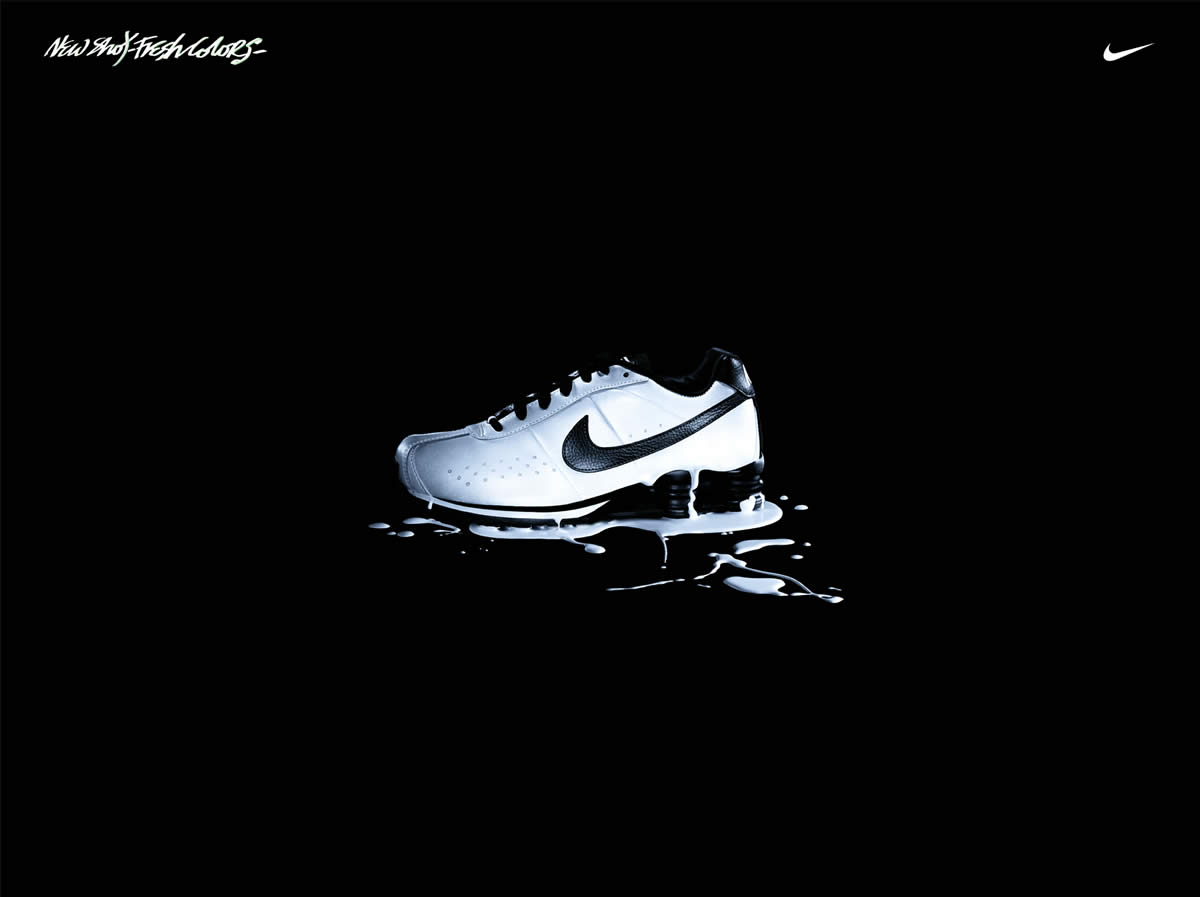
So far, by researching existing Nike adverts, they tend to have black backgrounds, and then bright colours in the center and white text (if there is any). So I would put a bright gradient behind the shoe to make it stand out.
The shoes mainly face to the left, something that can easily be implemented.
As for the shapes I will be deliberating over how to go about them. At the moment though I think they will probably be the same colour as the shoe, to keep a bit of continuity.
However they don't have to be shapes, the covering object could just be a misty gradient of multiple colours, with slight transparency, so you can see that there is something beneath it, and when someone walks past the mist is blown away, revealing the shoe
Saturday, 11 December 2010

Friday, 10 December 2010
nike research
I have been looking at existing Nike print adverts and I have noticed that they tend to feature mainly black backgrounds, then bright colours surround the image of the shoe, making it stand out and give it extra emphasis. Here are a few examples (click to enlarge):


Wednesday, 8 December 2010
research: existing interactive displays
Shape Stamping
In this floor projection example, people are encouraged to stamp on the shapes. The camera pans up to the projection source. The way this camera set-up works is that they have the projector placed next to a sensor, which detects where the movement is, and tells the computer accordingly, as explained here
iBar
This is a very clever installation, when someone places an object on the bar it's position is found by the computer and is highlighted by light around it. When someone slides an object down the bar the light follows the object and creates a bolt of light down the bar.
I would guess that this is a very different set-up to what I will be doing, but the principles are similar to something I could create. By telling the computer to, when it detects an object, create an image or particles in the position of that object.
Monday, 6 December 2010
idea: object reveal
My idea thus far is to have an object reveal. This means that there will be a screen filled with objects (something related to Nike) and when a person walks past the camera will detect movement and send the objects flying away. This will reveal a fixed image beneath advertising the shoe.
I have created an animatic based on an earlier idea of incorporating magic into the shapes, but after a discussion with Sue and Seb we thought it best not to take that approach, but to go with something more distinguishable to Nike.
I have created an animatic based on an earlier idea of incorporating magic into the shapes, but after a discussion with Sue and Seb we thought it best not to take that approach, but to go with something more distinguishable to Nike.
Saturday, 4 December 2010
research: existing interactive displays
Interactive Apple Store
In this example there are a series of paused movie clips and when movement is detected they start playing, which grabs the attention of the person walking past
Interactive Nike Display
In this example a Nike product is revealed when people walk past the display, the shoe is underneath some shapes and when movement is detected the shapes are blown away to reveal the shoe. Which is a shame because this is exactly the same as the idea I had for this project!
Friday, 3 December 2010
research: lumin vision
LuminVision are
One particular video that caught my eye was number 12 "Object Reveal", which I think would be good to use for this project, with the shoe being the reveal object.
creators and suppliers of innovative Audio-Visual Effects such as the ADVIS Interactive Floor Projection System.They have many examples of interactive installations, as shown on their gallery page.
One particular video that caught my eye was number 12 "Object Reveal", which I think would be good to use for this project, with the shoe being the reveal object.
Wednesday, 1 December 2010
research: existing interactive displays
Interactive football floor display
In this example the projection detects movement and when that movement 'meets' the ball it flies off in the opposite direction, a simple concept but no doubt extremely difficult to execute!
Interactive Shark Reef Display
This example again detects movement and ripples the images beneath it. Perhaps, when movement is detected, a ripple/distortion filter is applied to give that disruption effect?
Subscribe to:
Posts (Atom)